On this page you can read the experience of participants from a variety of the activities and retreats that have been organised by SanghaSeva since 2004. If you have been on one of our retreats we would love to hear from you again please share your experience with us
When I come to write my bucket list, I’m pretty sure litter picking won’t be on it. I’m not really a litter-picking-type-of-person. As a casual observer of litter pickers, it seems to involve a lot of looking at the ground, bending down and touching dirty stuff. None of these things are particularly appealing to me. And, as someone who tends to enjoy The Great Outdoors with their head in the clouds, litter isn’t something which generally gets my blood boiling.
So, imagine my surprise when I agreed to join a sangha-flavoured-litter-picking-meditation-exercise-type-thing. Inspired by a member of the sangha whom I very much like and respect, against my better judgement, I half-heartedly signed up. I immediately regretted it. This wasn’t BIG NEWS to me though, as I have a tendency to think too much about making commitments and then immediately beat myself up about it when I do persuade myself to make one. Anyway, I agreed to litter pick and I was going to do it … and my husband was going to do it with me once I figured out how to tell him!
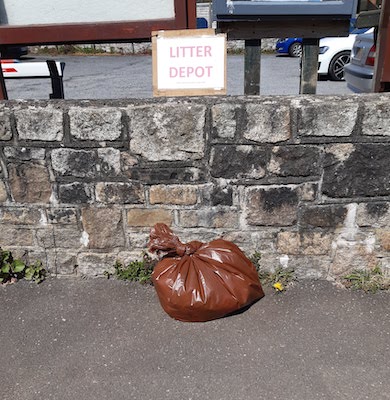
Cometh the hour, cometh the litter pickers … on a bright and windy morning, clad in disposable gloves and sporting appropriate litter retention receptacles, we stepped out of our front door with the steely-eyed determination
appropriate to the task at hand. Within a few metres of the start line the neighbourhood echoed to the familiar litter pickers’ chorus:
“Hey, that’s my bit of plastic - stick to your own side of the road!”
“I saw
it first, it goes in my bag - it’s the litter picking code.”
“There is no litter picking code - you're stealing my litter!”
“It’s only yours when it’s in your bag … up until then it falls under common grazing rights
as laid down in law in the 16th century.”
Anyway, once things settled down and the initial euphoria of ‘doing good work’ had waned, we settled into a surprisingly peaceful and rhythmic movement of sweeping down the lane focussing on the simple and repetitive task of spotting litter, bending down to pick it up, and putting it in our bag. It was quite a revelation. For minutes at a time, everything else fell away except these simple actions. It was no longer me picking up litter, but litter picking happening.
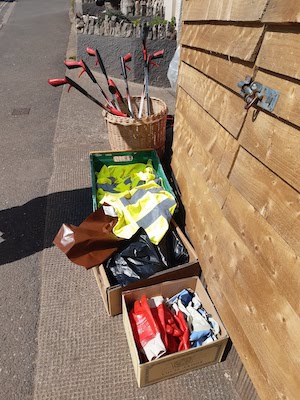
As we continued towards the village I felt a companionable silence with my husband and a strange togetherness with the world around us. Knowing that others were simultaneously engaged in the same simple actions around the world was strangely uplifting and grounding all at once. As we turned the corner into the centre of the village an even more strange sight confronted us. A litter picker’s Alladin’s cave! A barrel full of grabber sticks, litter sacks, fluorescent vests … by some bizarre alignment of the stars, or something, it turned out to be the Annual Parish Litter Picking Day! Not only were we working in community with each other and the sangha, but also with the whole parish. Someone, somewhere, was trying very hard to tell me something!
I’ve often felt a reluctance to join in with community activities, holding back despite a desire to come forward; a reigning in, you could say, of all my healthy impulses! This is partly due to a fear of not being good enough, or being able to do enough, or that any commitment will create expectations which will eventually overwhelm me. But today felt different. I recalled a beautiful line from the initial prayer that is read out in the weekly jhana group I attend:
"May we hold our reactions, our self-judgements, our contractions, and our comparisons in kindness, understanding their dependence on conditions."
There was something very special about today. I started the day thinking: why should I pick up litter? … and ended it thinking: why shouldn’t I? The trick now is to build that thinking into other areas of my life.
Tina Kennedy
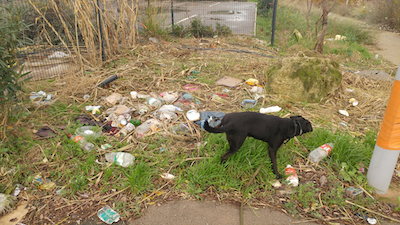
It was just a pile of rubbish. Just the entrance of the alleyway, my focus was the alleyway itself, where I walk my dog, who loves sniffing and chewing the scattered plastic, bits of chicken, ripped muddy rugby balls, dirty wet boxer shorts and what-not.
So I wanted to clean the alleyway. But I started with that big pile just before it, because it was so big and yukky and surely it wouldn’t take long, just shove it all in bags, done. I wore pink rubber washing-up gloves, and had 2 big black bin bags to start with, one for recycling and the other for the rest. Tied my dog Pecan not far.
My matter-of-fact, organised, just-pick-it-up-and-put-it-in-the-bag mind was soon wincing at the sheer quantity of stuff, layer upon layer, wet rotting stinking mush of everything. Wet heavy soiled falling-apart pizza boxes with rotting egg shells, minging soiled nappies, rusty old sharp pointy metallic things ripping my bin bag, were they going to rip through my thin rubber gloves? Shiver… I couldn’t just stay detached and efficient, I was overwhelmed by disgust.
“You might have negative mind-states” had said Nathan.
Yep, plenty of that. WHAT ARE PEOPLE THINKING, THIS IS A ROAD SIDE WITH PEOPLE WALKING ON IT, WHY DO THEY THROW THEIR STUFF HERE IT’S REVOLTING. No Sonia, don’t go there, breathe,
stay focussed, do it, finish it, so you can get onto the alleyway. I felt queasy, shaky. Repulsion. Aaargh, what am I touching?! What is this?!! Damn, yuk, Christ Almighty…
I did manage to finish that bit. Had taken a picture of the pile of rubbish, I took a picture of that little area now cleared. I did not feel satisfied and proud, though, to have given that area back to nature. I felt disgust, queasiness. And I was so shaky I needed a break, I needed a nice place to sit, with grass and loveliness and no trash. And I hadn’t even started on the alleyway…
What had Nathan said? “Pause, and…”? Never mind, let’s start with Pause.
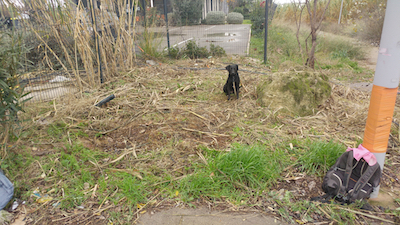
I took Pecan further down the grassy alleyways between the industrial estate buildings. I know he loves these bits, I can take him off the leash and he runs
like a loon all happy. I found a spot to sit, among the bamboo and the grass, without a single bit of plastic rubbish around. Drank my tea, ate some biscuits (No Pecan, they are mine), listened to some nice music, especially Danit’s
lovely “Naturaleza”.
I felt disappointed in myself, in my overwhelming emotions, in my disgust. Disappointed to have done so little, even though I’d filled 3 bags and put 3 others in the recycling. But the spot was so small, and it was not even part of my objective. I was disappointed also in how quickly I’d done it. I had been so disgusted that I had not been able to enjoy doing it, take my time. I had wanted to practice mindfulness, but had been caught in performance. Or maybe just in horror and wanting it over with as quickly as possible.
I took my phone, and saw photos and comments from the others. In England, Wales, Scotland, Sweden, Finland and the Netherlands, others were doing the same, at the same time, and sharing what they saw, the beautiful or the surprising. I felt so uplifted by this, by the connection, the sharing, the care. What a lovely beach, oh a squirrel, oh these beautiful long yellow grasses… I felt grateful of that sharing. Grateful for these many hands and hearts being of service to the Earth, to the community. Bringing care, presence, mindfulness, love, each in its small way, and each heart filling itself with peace and beauty in doing so.
I then found another spot a bit further, more open, with long green wet soft grass and muddy soil. I walked very, very slowly on it. Focussing on my steps, on the sensation of the tufts of grass, the soil, my feet. My breath. Slowly, very slowly, while Pecan was practising to be a racing car at Silverstone, running loops flat out like a crazy dog that he is, I gradually felt my angst melt into the ground, I connected with Earth again, I remembered with relief that I am Earth, I am part of this soil and grass and this lovely tree with yellow leaves over there. I put my hand on the red trunk of a pine tree, I love pine trees… Thank you tree for welcoming me, my emotions, my presence. No Pecan, stop pulling on this branch, it’s not a stick, it’s still attached to the tree!! Sorry Tree, excuse my dog. And feeling the tree welcome me, absorb my wobbliness, and give out its strength, patience, slowness to me.
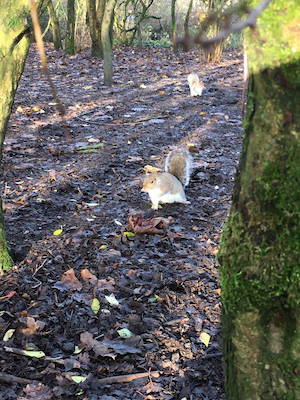
At the end of the day, when we all gathered again to share what had moved us, I felt grateful and warm to all these “Litter Pickers Anonymous”. Yes it’s true, I didn’t reach my objective. Yes I only did a bit. Yes maybe in a couple of weeks it’ll be trashy again (please please no). But I did it. I made a start. I showed myself that I could. Maybe others will see that it’s possible, maybe others will follow.
In France there is a big movement of people called “the Hummingbirds” (Les Colibris). These people all around the country endeavour to create a fairer, simpler, more ethical way of living. Each doing their part. Like the story of the hummingbird carrying a drop of water in its beak to help extinguish the forest fire. Doing its bit.
So I didn’t clear the whole alleyway. I did not reach my objective. But I was not on a mission, I was on a Sacred Places retreat, and exploring how to clear an area mindfully, how to feel connected to the Earth, and to myself, in the process. I did my little hummingbird bit. Pause, Listen, Notice, Open. And my heart did feel, and open, and connect, and remember that it is Earth.
Sonia Bressey
I rest my hands on the warm bark of a split olive trunk, feeling its rough wrinkled skin on mine. This tree, scarred though centuries of growth, and dripping with ripened fruit, stands like a living statue of resilience.
Walking through the red soil, still sticky from yesterday’s rain, I navigate the now familiar limestone sticking
up like sharp ancient bones from the earth. The smell of soil, bark and olive leaves surround me, and above, the unwieldy branches twist upwards, leaves hanging haphazardly against the blue sky.
The call for prayer rises mournfully from the belly of the earth, reverberating around the hills until it settles quietly within my soul. Into the ensuing silence we are invited to call out the sights and sounds of Palestine
as we walk rhythmically around the trees and over the rocks. Our voices call out, like a chant, a small prayer…
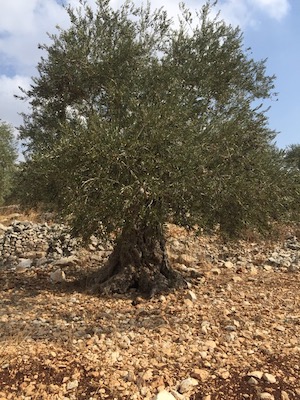
We continue to walk slowly, the soil collecting on the soles of our shoes. Looking around me I see the circle we are forming as we walk, sometimes meandering round an olive tree or standing up on a larger boulder. I call out into the silence
“The passionate hopes of young people”.
I smile as I remember the conversations, Sana who wishes to study media and eager to show tourists the land, history and people of Palestine. Ibrahim who is supporting his family with love
and pride, in spite of all the hardships he faces.
“The school children calling out ‘hello’” Sarah chips in, just as I’m remembering the children in the olive groves trying out songs from around the world, embracing unfamiliar languages, transcending boundaries and history.
Chris invites my straying mind to return
“The voice of Aziz who has no hope of seeing his son again and doesn’t want to live anymore”
I try to imagine what it would be like if our sons in the UK had to leave our country and due
to an occupation, could never return. Never to be able to hug them again, never to be able to sit alongside each other sharing feasts and weaving dreams together. Yet knowing their leaving would set them free, it’s an unbearable dilemma.
Pause and breathe
I notice my breath and the ancient trees I am immersed in. I climb up onto a smooth boulder that stands firm in our moving circle, independent of our narrative, independent of time. Our group walking slowly, reflecting, mindful that each step we take, is another step towards a new beginning. Small steps in the hope that others will join in.
Zohar speaks with a focused, steady voice, an Israeli on Palestinian land intent on transcending the destructive boundaries that people create.
“Volunteers giving Issa a lift to the olive groves, packing his wheelchair into his car.”
Issa continues to work, to move forward, immersed in a dance with freedom. I stand in admiration of his refusal to hold hatred in his heart. He demonstrates that peace is not a passive state of mind to obtain, peace needs cultivating.
Pause and breathe
“The stories of prison and collective punishment.” Linda is walking, deep in reflection. We are all merged into the depths of human suffering with these Palestinians who have opened their hearts to us. Healing is a collective endeavour
and an honour.
Pause and breathe
“Feasting in the olive groves” calls out Nathan joyfully. Feasts laid out under a canopy of soft green leaves that cast welcome shadows onto the ground. We sat on the warm earth around bowls of hummus, yoghurt and pickled vegetables with
stacks of fresh pita bread to mop it all up. The families urged us to join in the eating and the conversations that were mingled with laughter and tears.
I can still smell the fresh sage gathered for a sweet tea.
We walk, we pause, we breathe
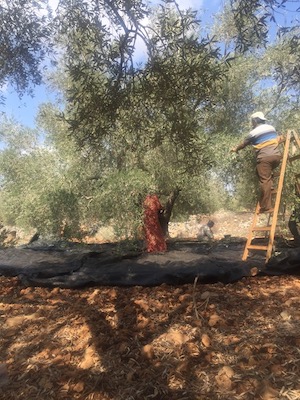
I feel the warm breath of the wind on my face and look up at the sunlight sparkling though the pale green leaves that dance in the gentle breeze.
We walk, we pause, we breathe
I feel the silky leaves hanging from a young tree and rub a ripened olive between my fingers to reveal its glistening purple gold.
We walk, we pause, we breathe
I hear the pattering of olives as they fall onto the tarpaulin placed beneath the tree. I close my eyes and see olives raining down in front of me. I am the abundant tree from which they fall; I am the harvest; I am this land;
I am these people.
We walk, we pause, we breathe
Until all that remains are footprints in the silence.
Liz Mason